Six stories this week, and they all point the same way: learn it yourself first, then let AI help you practise. Thirty learning scientists, in a University of Minnesota consensus report, say careless AI use poses a “severe and one-sided” risk to critical thinking but can help at the practice stage. Reuters finds US teachers moving essays and tests back into the classroom. A survey of more than 5,500 US pupils finds 58% use chatbots for schoolwork and 57% turn to them when they’re struggling. In South Korea, a regional schools chief says he’s considering banning generative AI up to middle school, as a national survey finds 72% of student AI users sometimes hand their assignments to AI. Google adds interactive “immersive explorations” to Gemini’s student hub. And a Fields Medal-winning Berkeley professor has stopped marking homework for correctness. The takeaway for families: the first attempt should be your child’s own.
1. Thirty experts: AI can help with practice, but careless use threatens how children learn
Source: Elizabeth Shockman, MPR News · 28 October 2026 · report: University of Minnesota expert consensus report
University of Minnesota researchers asked 30 learning scientists and education researchers how generative AI affects learning from kindergarten to university. The experts identified 65 learning processes AI can affect and reached consensus on 42. Their headline, which they call the “GenAI Paradox”: “casual, careless use of general-purpose GenAI can threaten the very learning processes necessary for committing new ideas to memory… and also the higher-order thinking needed to deeply understand and use these ideas in novel ways.” But AI can help with the middle step, practising and consolidating something already learned. Their advice: learn first without AI, use AI to strengthen that understanding, then prioritise your own thinking when you apply it. The risk to critical thinking and self-regulated learning was rated “severe and one-sided”, with extra caution urged for primary-age children. Lead author Panayiota Kendeou told MPR: “If I were a teacher, I would definitely not provide access to my students if my goal is for them to develop certain skills.”
X reaction: No X posts about the report found yet.
Video angle: “Thirty learning scientists looked at how AI affects learning, and their answer fits on a sticky note: learn it first, then use AI.”
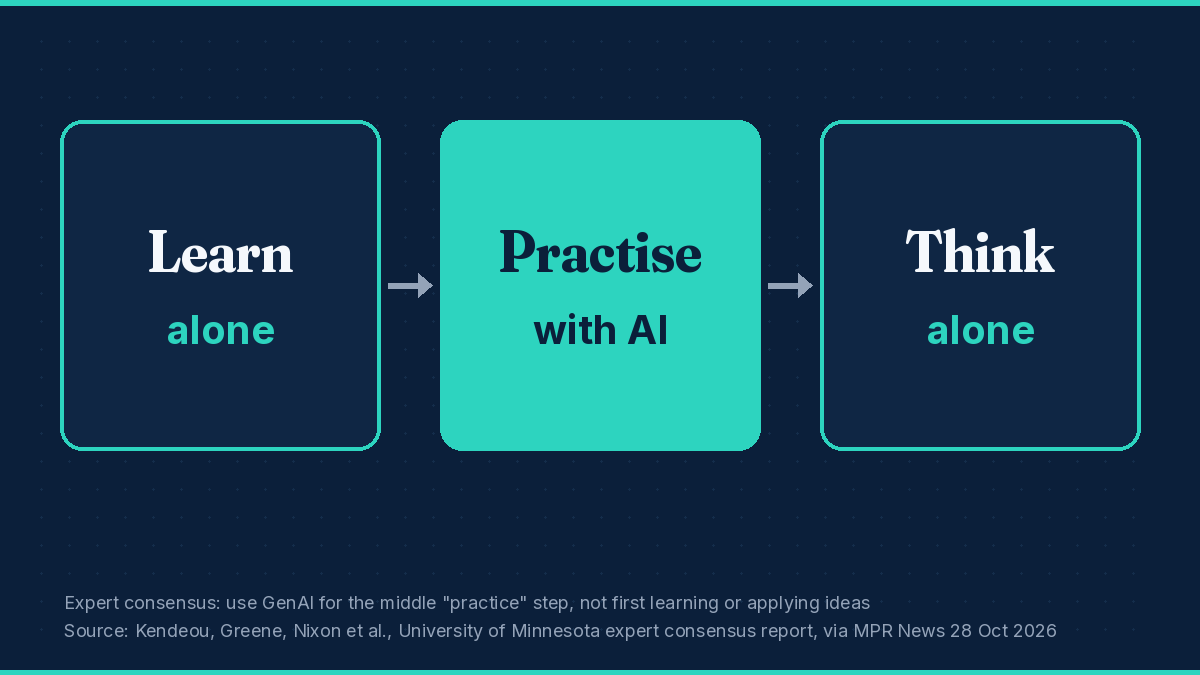
The experts’ three steps. Source: University of Minnesota expert consensus report, via MPR News, 28 Oct 2026.
2. Reuters: US teachers are bringing essays and tests back into the classroom
Source: Helen Coster, Reuters (via CNA) · 28 October 2026
Reuters interviewed a dozen US teachers and education experts. Teachers are setting less take-home work, doing more writing and discussion in class, and redesigning tasks to measure thinking rather than answers. San Francisco teacher Tristen Chang replaced take-home essays with five-minute oral exams: “AI is the most drastic… Everything’s out the window.” A New York maths teacher sets fewer homework questions and more in-class practice, and asks students which method they prefer and why. One English teacher found students slipping off to the bathroom to use AI on their phones, so phones now stay behind. A Chicago-area teacher limits laptops to about 10% of school days: “you can’t hide when the laptops are away.” Others use AI to adapt reading levels or start research.
X reaction: Mostly link shares, e.g. @gmanews and @kathmandupost.
Video angle: “One teacher swapped essays for a five-minute oral exam. Another makes students leave their phones behind when they go to the toilet.”
3. Survey: most US teens use AI for schoolwork, and almost as many when they’re struggling
Source: The Jed Foundation · 27 October 2026 · coverage: Rhitu Chatterjee, NPR · 28 October 2026
JED, a US youth mental-health charity, surveyed more than 5,500 middle and high school students at 21 US schools. Students use AI for schoolwork (58%), when sad, stressed, lonely or overwhelmed (57%), for relationship or problem-solving advice (28%) and for friendship or companionship (12%). Some uses were linked with poorer mental health: students who used AI for homework reported more loneliness, and those using it for companionship reported more anxiety, depression and loneliness. JED’s Dr Kayla Anderson told NPR it is “unclear” whether AI use causes poorer wellbeing or whether students who are already struggling turn to AI more. JED says AI “should never be positioned as a substitute for trusted adults.”
If you or a young person you know is struggling, in the UK you can call Samaritans free on 116 123, any time. Children and young people can call Childline free on 0800 1111.
X reaction: Very little discussion found on X so far.
Video angle: “More than half of teenagers in a new survey use AI for schoolwork, and nearly as many use it when they’re sad or stressed.”
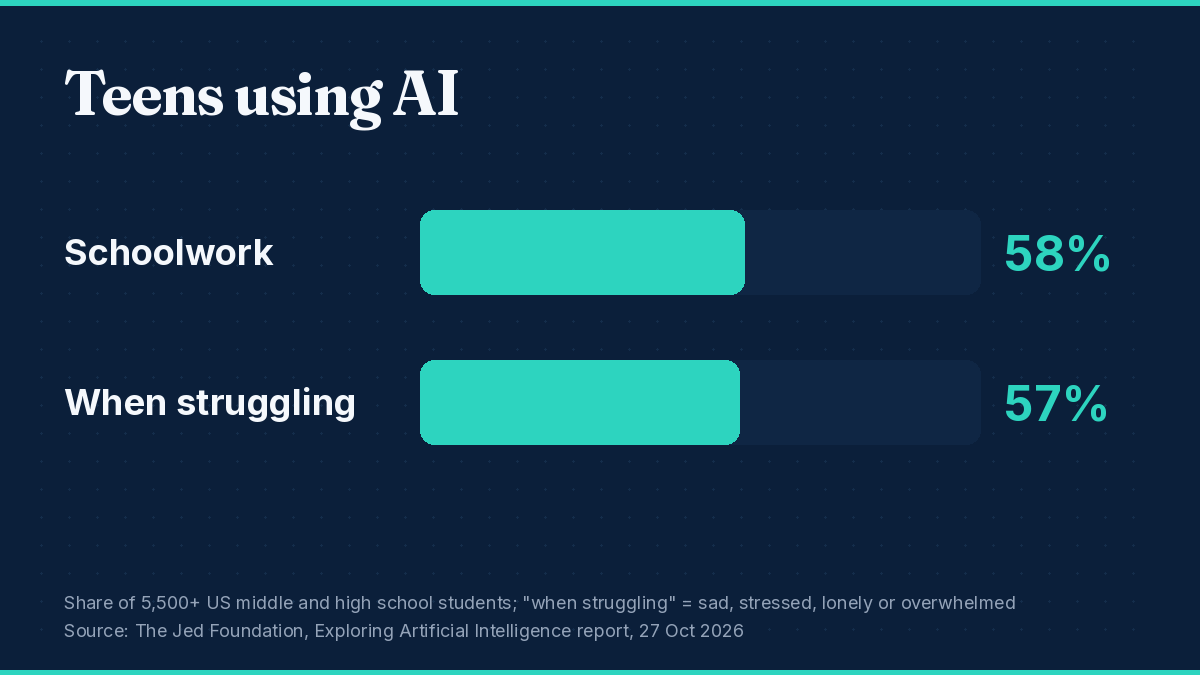
How US middle and high school students use AI. Source: The Jed Foundation, 27 Oct 2026.
4. South Korea: schools chief floats a generative-AI ban up to middle school
Source: Lee Young-joo, Yonhap News (Korean) · 27 October 2026 · also Ko Mi-hye, Yonhap News (Korean) · 28 October 2026
Ahn Min-suk, superintendent of the Gyeonggi Provincial Office of Education, told a parents’ town hall on 27 October that, after leading the country on phone-free schools, he thinks generative AI should be banned up to middle school. His reasoning, roughly translated: children who don’t know something should think it through and solve it themselves, “but they just ask ChatGPT or Gemini… they are losing the ability to think.” He stressed that AI education would continue. It is under consideration, not policy. The next day, a Korea Press Foundation survey of 1,000 generative-AI users reported that among 305 students who use AI for study, 77% ask AI to summarise materials instead of reading them, 72.1% sometimes or often let AI do assignments for them, and about 4 in 10 use AI answers without checking them.
X reaction: Korean link shares, e.g. @News1_National, and scepticism from @bookmar58644391: “다 차치하고, 뭐 어떻게 찾아서 잡겠다는 건지” (roughly: “Setting all that aside, how exactly do they plan to find and catch it?”).
Video angle: “Korea led the world on phone-free schools. Now one region wants AI-free schools up to age 15.”
5. Google adds interactive “immersive explorations” to Gemini’s student hub
Source: Google Blog · 28 October 2026
The Gemini app now has a library of “immersive explorations”: interactive visual scenes students explore layer by layer, “from microscopic systems to deep space”. Google’s examples include Silk Road trade routes, the inside of a jet engine and the physics of lightning; you tap labels to zoom from planetary scale down to molecules and atoms. It’s in the Gemini student hub now, is coming to ordinary chats soon, and will get audio narration. It launches in English, Indonesian, Hindi, Brazilian Portuguese, French and simplified Chinese.
X reaction: Official launch posts from @GeminiApp (13,758 impressions) and @Google (21,608 impressions); replies mostly enthusiastic.
Video angle: “Google’s AI can now zoom you from a lightning bolt down to its atoms, but the real test is whether you can explain it afterwards.”
6. Fields Medal winner stops marking homework for correctness because of AI first reported 23 Oct
Source: The Daily Californian · 23 October 2026 · picked up by Tom’s Hardware · 27 October 2026
Richard Borcherds, a UC Berkeley maths professor and Fields Medal winner, no longer has homework graded for correctness. After seeing how many students used AI to get top scores, he felt there was “no point” paying readers to mark it; students now get credit for handing it in. He admitted it is “not a very good system” but said he has no alternative yet. Berkeley leaves AI rules to individual staff, after deciding detection tools weren’t good enough to standardise across campus.
X reaction: @lenny_enderle: “now: handed in = credit.” · A former teacher, @Acci_teacher: “Homework is practice. My math games never penalize a wrong answer. What would you grade instead?”
Video angle: “One of the world’s best mathematicians now gives homework credit just for handing it in, because AI made the marks meaningless.”
Learn it first, then use AI (Story 1, with Stories 2 and 6)
The Minnesota report gives the rule: learn alone, practise with AI, think alone. Reuters’ teachers and a Fields medallist show schools already acting on it. Runner-up: Korea’s AI-ban idea.
“Thirty learning scientists, a dozen teachers and a Fields Medal winner all landed on the same rule this week: learn it first, then use AI.”
Want this digest in your inbox? A short roundup of what’s actually changing in AI and learning.
Join the newsletter →