Seven stories, one question: who does the thinking? In England, 300+ experts want a pause on AI tutors for disadvantaged pupils. In the US, teachers are moving work back into the classroom with oral exams, the University of Chicago is making an AI-free writing course compulsory, and Seattle closed a back door to Gemini hidden inside Google Search. Liverpool City Region is training every school leader, Australian universities are labelling each task Can, Can’t or Must use AI, and the Philippines is teaching children to set boundaries with chatbots. The takeaway for families: decide task by task, and keep the first attempt human.
1. 300+ teachers, parents and doctors ask ministers to pause England’s AI tutor trial
Source: Sophie Huskisson, The Mirror · 8 November 2026
More than 300 teachers, parents, academics and doctors have written to Andy Burnham and Education Secretary Lucy Powell asking them to halt plans to give AI tutoring tools to up to 450,000 disadvantaged children from next year. The letter says these children “should not be the first to bear the risks of an unproven and contested technology”, and that hunger, absence and mental health “are not technological problems”. Signatories include the SafeScreens Campaign, Health Professionals for Safer Screens and Schools Beyond Screens. The government says it is “not a national rollout of AI tutors, but a carefully controlled trial” to test safety before anything is scaled up.
X reaction: @TheShallowEndAI (8 Nov, replying to the reporter): “If schools hit pause on AI tutors, families can still keep a simple rule at home: use it like a study partner that asks questions, not a service that writes the assignment.”
Video angle: “450,000 children could get an AI tutor next year. 300 experts say: not yet.”
2. Teachers swap take-home essays for oral exams and in-class writing
Source: Helen Coster, Reuters (via Arizona Daily Star) · 7 November 2026
Reuters interviewed a dozen US teachers and experts and found a clear shift: less take-home work, more in-class writing, discussion and face-to-face assessment. A San Francisco sixth-grade teacher dropped take-home essays for five-minute oral exams of 15 questions; a New York maths teacher now sets fewer homework questions and more in-class practice so he can see how students work; another English teacher spends a month writing one essay with his class.
X reaction: @think1more (7 Nov) summarised three university responses: “Yale: in-person exams up from 14.8% to 20% … Hebrew U: oral exams, paper presentations”.
Video angle: “Teachers are bringing back the oral exam. Here’s why AI made it happen.”
3. University of Chicago will make an AI-free writing course compulsory for first-years
Source: Kathryn Palmer, Inside Higher Ed · 9 November 2026
UChicago has launched the Chicago Center for Writing, and from next autumn every first-year student must take an AI-free writing course run through it. The same roundup reports students at Eastern Illinois University petitioning for rules on how much professors rely on AI for course materials (529 signatures), and a Berkeley tool, Rubrica, that grades handwritten exams against a rubric, matching human scores 85% of the time in a small study, with the instructor reviewing every grade.
X reaction: No X reaction found for the UChicago course in this window (searched 7–9 Nov).
Video angle: “One of America’s top universities just banned AI from a compulsory class.”
4. Seattle schools close a back door to Gemini through Google Search
Source: The Seattle Times · 7 November 2026; background: Gothamist · 6 November 2026
Seattle Public Schools already blocks chatbots such as Claude and Grok, but students found that clicking the AI summary in Google Search opened a Gemini chat. From this week a web-filter update closes that route, alongside blocking YouTube for K–5 and Minecraft (except where teachers use it), and a 60-minute daily screen cap for grades 3–5. The district hasn’t banned generative AI: approved tools such as MagicSchool AI, Canva Magic Write and Adobe Firefly stay. In New York, Gothamist reports the city has disabled Gemini and AI Mode on student Chromebooks and asked Google to remove AI Overviews, after last week’s row over Google tying Search to AI.
X reaction: @SEATTLESUBMISS (9 Nov, about 1.4k views) shared the change as “Seattle Public Schools to Block Minecraft and Google Gemini for All Students, Along With YouTube for Grades K–5”.
Video angle: “Students found a secret door to an AI chatbot inside Google Search. Seattle just shut it.”
5. Liverpool City Region opens free AI training to every school leader
Source: Labour Home · 8 November 2026; Mersey Monitor (week of 2 Nov)
The Liverpool City Region Combined Authority announced its largest regional rollout of the Big AI Project: free training, resources and guidance on safe, ethical AI use for headteachers, trust leaders and staff, designed by teachers through the Oasis Big Education Institute and described as technology-neutral. Earlier the same week it expanded a Century Tech personalised-learning platform to 20 secondary schools and more than 3,000 pupils, after a primary pilot with nearly 5,000 children. Mersey Monitor notes Century Tech’s chair is Lord Jim Knight, a Labour peer and former schools minister.
X reaction: No X reaction found in this window (not searched separately).
Video angle: “A whole UK region just offered every head teacher free AI training. Here’s what’s in it.”
6. Australia: four universities widen ChatGPT Edu, with “Can, Can’t, Must” rules for assessments
Source: Mara Sugue, ITBrief · 9 November 2026
OpenAI has expanded partnerships with UNSW Sydney, the University of Sydney, La Trobe and Adelaide University. UNSW is extending ChatGPT Edu to more than 80,000 students and staff, and has a Can, Can’t, Must framework where each assessed task says whether AI is permitted, prohibited or required. Sydney assesses unaided knowledge in supervised settings and AI use in open tasks. An OpenAI-commissioned survey of 1,018 Australian students found 81% use AI several times a week and 33% several times a day.
X reaction: @eduitguy (7 Nov): “To me it’s unis moving to managed access with clear rules, a shift worth school IT watching.”
Video angle: “Can, Can’t, Must: the simplest AI rule for homework I’ve seen.”
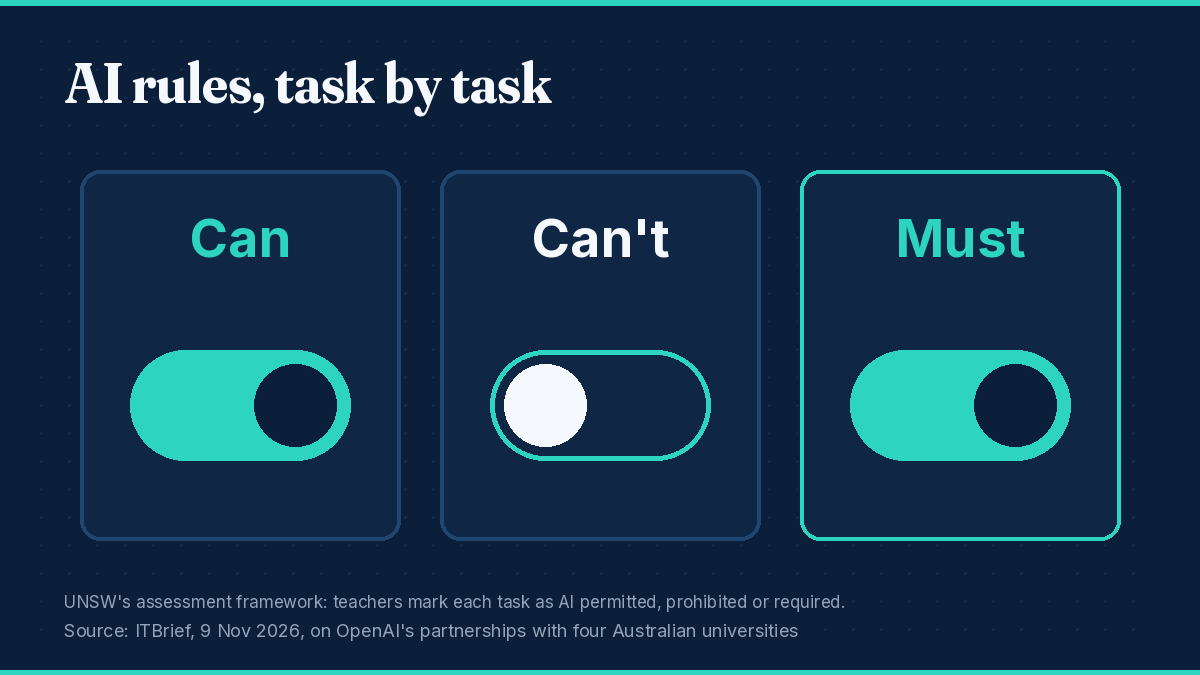
UNSW’s Can, Can’t, Must assessment framework. Source: ITBrief, 9 Nov 2026.
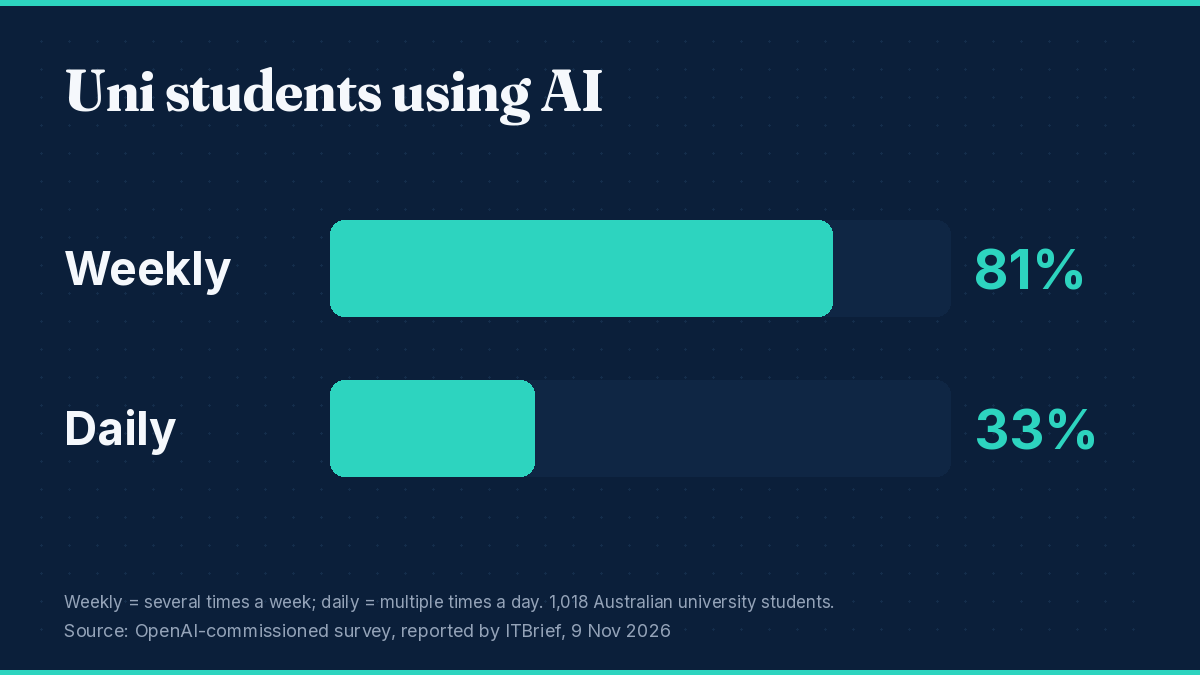
How often Australian university students use AI. Source: OpenAI-commissioned survey via ITBrief, 9 Nov 2026.
7. Philippines: Microsoft and DepEd to train 2,000 teachers in AI and chatbot safety
Source: Jinji Quiambao, NewsBytes.PH · 7 November 2026
Microsoft and the Department of Education will train and credential 2,000 public school teachers in AI literacy, with sessions from November to May. Alongside Microsoft Elevate for Educators and an AI Classroom Toolkit, a student-safety resource called Behind the Chat uses fictional teen scenarios to cover privacy, oversharing, AI-assisted decisions and emotional attachment to chatbots, with guidance for parents too.
X reaction: No X reaction found in this window (not searched separately).
Video angle: “A country is teaching kids not to get attached to chatbots. Should we?”
Want this digest in your inbox? A short roundup of what’s actually changing in AI and learning.
Join the newsletter →