Hero board in the navy / teal house style. Today’s theme: students do the thinking first, then use AI.
Six stories for parents and teachers today, and one theme runs through most of them: AI only helps if students still do the thinking. Australia’s national education research body tells schools to use AI “sparingly”, with none at all in the first three years of primary. In the UK, 77% of Russell Group undergraduates say they’re taught “little or nothing” about AI, and an early UCLA study links answer-giving AI to weaker independent thinking. Also today: free teacher AI training from Anthropic (Coursera) and Google Philippines, principals building their own AI tools, and a 70-expert study on five priorities for fair AI in education.
1. AERO: Australian schools told to use AI “sparingly”
Source: Conor Duffy, ABC News · 14 October 2026
The Australian Education Research Organisation (AERO), jointly funded by Commonwealth and state governments, has issued new advice to schools. CEO Dr Jenny Donovan warns of “cognitive outsourcing”, which she describes as “when you rely on the tool to do the thinking for you”. AI can create an illusion of learning: she cites overseas studies where students couldn’t replicate their AI-assisted results in exams without the tool. AERO says to avoid AI completely in the first three years of primary school, then use it carefully alongside established practice such as explicit instruction. Donovan says AI does matter in high school, backs NSW-style bespoke tools that guide students through reasoning rather than handing over answers, and warns parents against “unfettered access” to tools like ChatGPT at home. Education Minister Jason Clare linked heavy screen use to lower PISA scores and called for “a bit of a digital detox”.
X reaction: @abcnewslatest (1 like, 83 impressions) · @sandyisadorax · @TheEducatorAU. Low engagement so far, mostly news shares.
Video angle: “Australia just told schools to use AI sparingly. Here’s what ‘cognitive outsourcing’ means for your child.”
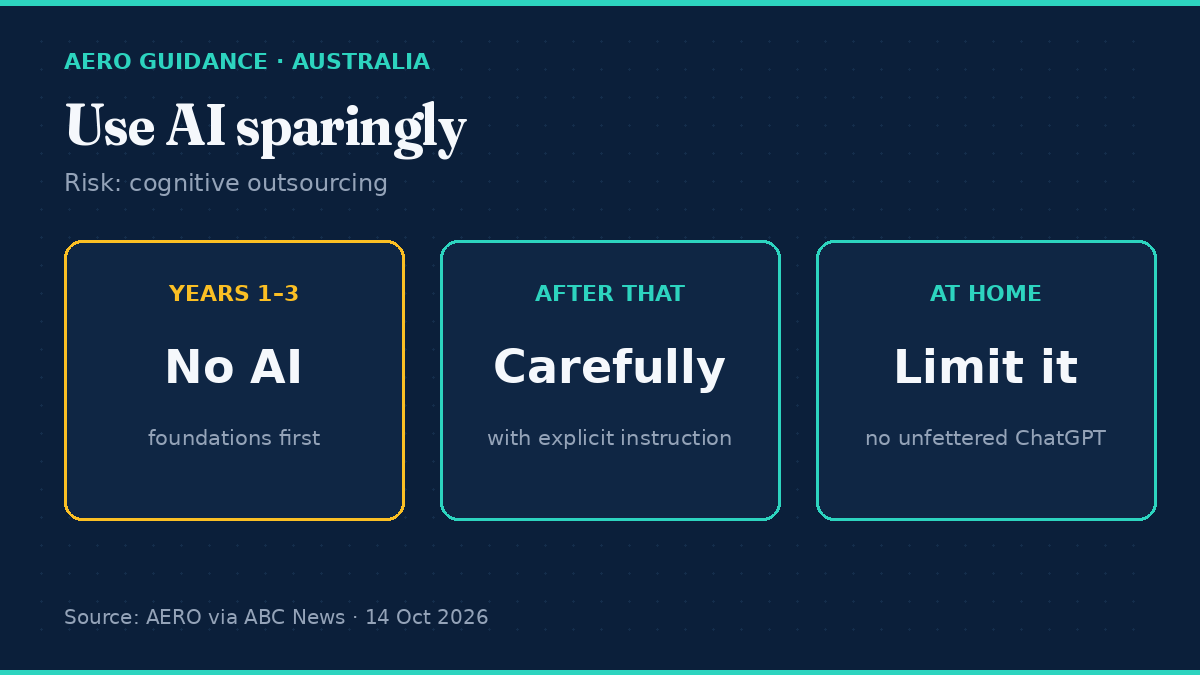
AERO’s staged advice at a glance. Source: ABC News, 14 Oct 2026.
2. UK: Russell Group students report little AI teaching; UCLA study flags over-reliance
Source: Georgia Luckhurst, Times Higher Education · 15 October 2026
Bett UK’s A Degree of Doubt report surveyed more than 1,000 UK undergraduates. 77% at Russell Group universities say they’re taught “little or nothing” about AI, against 64% at post-92s, and 62% of Russell Group students say the AI teaching they do get is mainly about assessment rules. Health and medicine students were the most likely to say AI isn’t really covered, despite a £20m government commitment to roll out AI services to every NHS trust in England. 78% would have been interested in a shorter, “technology-personalised degree”. Separately, the Cambridge AI in Education Summit will hear early results from a UCLA study of 450 students: frequent use of answer-giving AI improves short-term performance, but those students are weaker independent thinkers. Universities UK pointed to its commitment to “embedding AI into every course”. The Russell Group’s Joanna Burton said its universities are “setting clearer rules for assessments but also designing and adapting curricula”, and “remain confident that our courses set graduates up for success”.
X reaction: @timeshighered (2 likes, 2 reposts, 840 impressions, 2 bookmarks) · @HEontap
Video angle: “77% of Russell Group students say they’re taught little or nothing about AI. Here’s what to ask before you apply.”
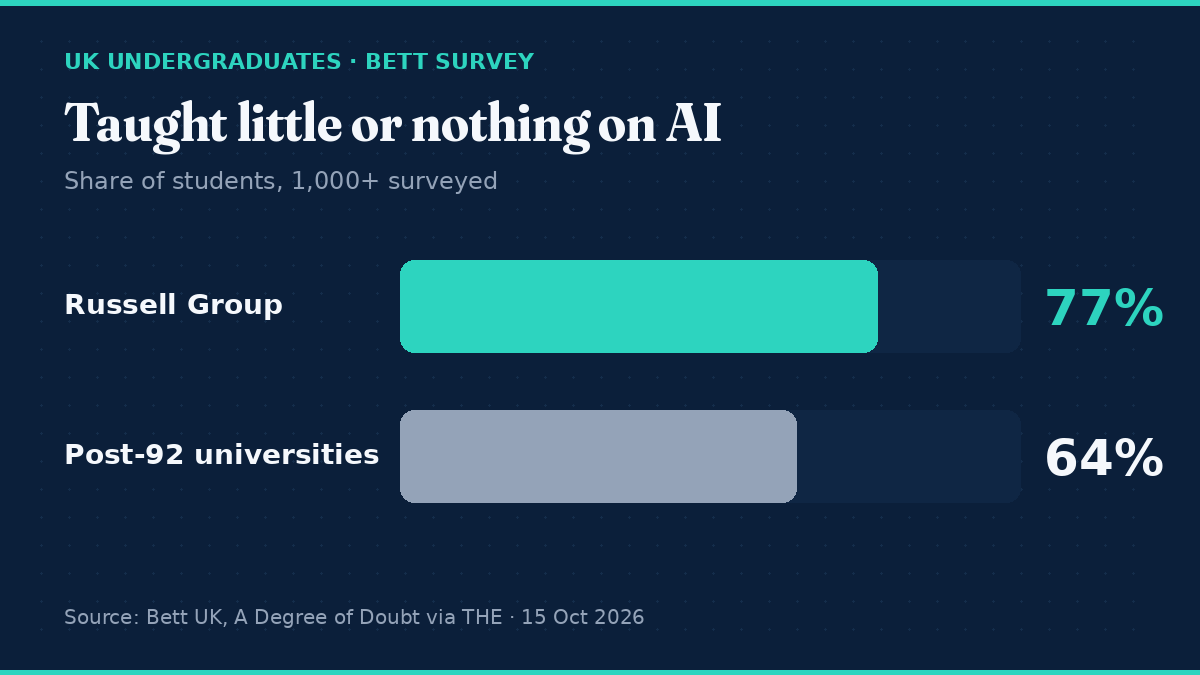
The AI teaching gap, in students’ own words. Source: Bett UK via THE, 15 Oct 2026.
3. Anthropic releases free Coursera AI courses for pK-12 teachers
Source: The Learning Standard · 14 October 2026
Anthropic has released 10 free courses on Coursera. Two are for schools: “AI Fluency for pK-12 Educators”, built with Teach for America to help teachers adapt classroom activities while protecting student data, and “AI Fluency for pK-12 Train the Trainer”, built with the American Federation of Teachers, which includes a workshop facilitator guide for training colleagues. Others cover creative work and Claude “subagents” for developers. The article also covers the US privacy rules: under FERPA, districts need Data Privacy Agreements before sharing student data with AI platforms. The AFT and UFT worked with Microsoft on a National AI Safety & Privacy Standard that stops companies training AI models on student and teacher data.
X reaction: @lmoroney: “Where should a teacher start with AI if the school hasn't offered any training yet?” (547 impressions, 2 replies, 1 bookmark)
Video angle: “Free AI training for teachers from Anthropic: what’s in the two pK-12 courses and who built them.”
4. Google Philippines launches AI Educator Series, aiming to reach 1 million teachers
Source: Jem Sagcal, Inquirer Technology · 14 October 2026 (launched 13 October)
Google Philippines launched the free, bite-sized Google AI Educator Series (GES) with DepEd, CHED and TESDA. DepEd will endorse it nationwide, and NEAP accreditation will give teachers CPD credit units for PRC licence renewal. The aim is to upskill more than one million public school teachers. CHED will advise universities that GES is an optional resource, and TESDA has embedded it in its free online programme. The Inquirer reports a Google study as finding that “86 percent of Filipino educators are inclined to use AI, but only 17 percent feel that they lack the training to do so”, and a UNESCO survey finding 50% with low confidence in AI. DepEd Secretary Sonny Angara said the training lets teachers spend “less time on paperwork”. Google’s Prep Palacios said AI “cannot replace the heart of a teacher”.
X reaction: No strong X reaction found in the digest window, only low-engagement official and news shares (e.g. @tesdaofficial).
Video angle: “The Philippines wants a million teachers trained in AI, and they’ll earn licence credits for it.”
5. EdWeek: principals build AI tools for absenteeism, teacher goals and trackers
Source: Olina Banerji, Education Week · 14 October 2026
Derek Cantrell, principal of Allegheny High School in Covington, Virginia, builds custom AI tools for teacher observations, PD planning and graduation tracking. His absenteeism system warns students near their limit, lets them “earn back” good standing, and rewards progress with cafeteria points. His warning: “You don’t want to put student data into things that go out into the public domain.” Sterling Seeman (Springer Middle, Wilmington, Delaware) wrote AI prompts for teachers’ yearly goals. Rachel Jensen (Idaho Home Learning Academy) uses AI trackers for teachers overseeing 90+ students per grade. Seeman won’t let AI write his personal emails. Cantrell’s student guidelines allow AI for summarising, outlining and editing, as long as students check for hallucinations.
X reaction: No strong X reaction found in the digest window.
Video angle: “Principals are building their own AI tools, and one turned absenteeism into an earn-back points system.”
6. Kumamoto Delphi study: five priorities for AI without leaving anyone behind
Source: phys.org / Kumamoto University · 14 October 2026 · Paper: Majumdar et al., Computers and Education Open, DOI 10.1016/j.caeo.2026.100405
A Delphi study led by Associate Professor Rwitajit Majumdar polled 70 experts from 18 countries. Their five priorities: (1) AI competencies for learners and educators (rated highest); (2) automated formative assessment and feedback; (3) teachers as orchestrators working alongside AI agents; (4) explainability and trustworthiness; (5) accessibility and equal access. The authors argue that AI adoption isn’t purely a technology question. Education is an ecosystem of learners, teachers, institutions, data, infrastructure and policy, and all of them need to move together.
X reaction: No strong X reaction found in the digest window.
Video angle: “70 experts, 18 countries, 5 priorities: what AI in schools should get right first.”
AERO: cognitive outsourcing and “use AI sparingly”
A clear, usable rule for parents from a government-funded research body: no AI in the first three years of primary, use it carefully after that, and limit it at home. The UCLA over-reliance finding (Story 2) supports it, and the Russell Group 77% gap is the runner-up for a separate UK sixth-form/UCAS video.
“Your child got the right answer with AI. Could they get it again without it? Australia’s education research body says that’s the problem, and it has a name: cognitive outsourcing.”
Want this digest in your inbox? A short roundup of what’s actually changing in AI and learning.
Join the newsletter →