Seven stories, and most of them ask one question: is a higher score the same as more learning? A New York Times investigation found that fewer than half of the students at Alpha School, the AI-first private school network, hit its “learn twice as fast” promise in both maths and reading. A new research roundup reports that an AI tutor lifted homework scores but made no difference on an exam taken without it. In South Korea, about 600 students must resit a midterm after one boasted of scoring 99 with AI. Elsewhere, Oxford and the DfE start work today on how pupils’ data should (and shouldn’t) feed AI, India puts a 20-hour AI module into secondary schools, Bihar signs up 11 tech firms to train teachers, and Australia’s teachers’ union says AI has moved their workload rather than cut it. The takeaway for families: judge AI by what your child can do when the tool is closed.
1. NYT: fewer than half of Alpha School students hit its “2x” AI learning promise 23 Oct · 72h window
Source: Dana Goldstein, The New York Times · 23 October 2026
Alpha School is a for-profit network of private schools where academics take two to three hours a day on apps, with no traditional teachers. It markets “2x in two hours”. The Times reviewed Alpha’s own data for about 400 K–8 students from fall 2025 to early 2026. Most are high achievers (median at the 87th percentile nationally in maths and the 89th in reading), and 75% advanced at least as fast as national averages. But only 42% met the “2x” growth standard in both maths and reading. Of the students who started at or below the 50th percentile in maths, only 37% hit 2x. The software also reaches about 2,600 public-school students in Texas and South Carolina. Houston’s superintendent said pilot students spent longer than expected on the apps, and cognitive psychologist Daniel Willingham called the approach “naïve theories of psychology”. Alpha declined to answer the Times’ questions.
X reaction: @Techmeme (13,222 impressions) · pushback from @RobDonnelly47: “The NYT article about Alpha school tried so hard to frame the results as negative even though they seem super impressive.” · @EdTechMuser on the “mic drop ending” by @DTWillingham.
Video angle: “An AI school promised your child would learn twice as fast. Its own numbers say fewer than half did.”
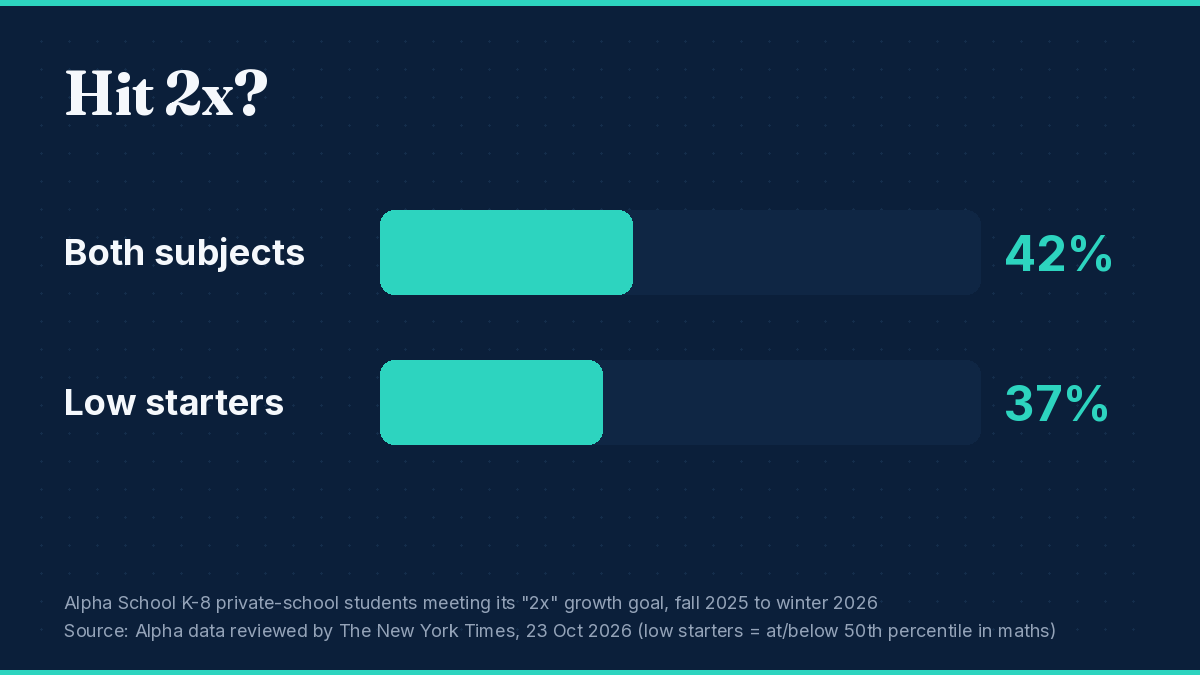
Share of Alpha School K–8 students meeting its “2x” goal. Source: Alpha data reviewed by The New York Times, 23 Oct 2026.
2. Research roundup: an AI tutor lifted homework, not the exam
Source: AIEd Research Weekly Update #1, AI in Education Knowledge Base · 24 October 2026 (research summary)
The roundup’s headline: “a score is not the outcome”. In a randomised trial, 153 proof-writing students at Carnegie Mellon got an AI proof tutor early or late. Homework scores rose 2.56 points while the tool was available, but midterm scores on an exam taken with no AI did not differ. Once everyone had access, every 100 extra chatbot messages went with a 3.02-point lower score on the next exam, and less confident students used it most. In a separate Munich trial (275 computer-science students), exercise scores were 71.84% with a hint-giving tutor, 57.50% with unrestricted ChatGPT and 29.85% with the open web, but gains in conceptual knowledge did not differ between the groups.
X reaction: No X reaction to these studies found in the window.
Video angle: “In a real university trial, an AI tutor pushed homework scores up, and exam scores stayed exactly where they were.”
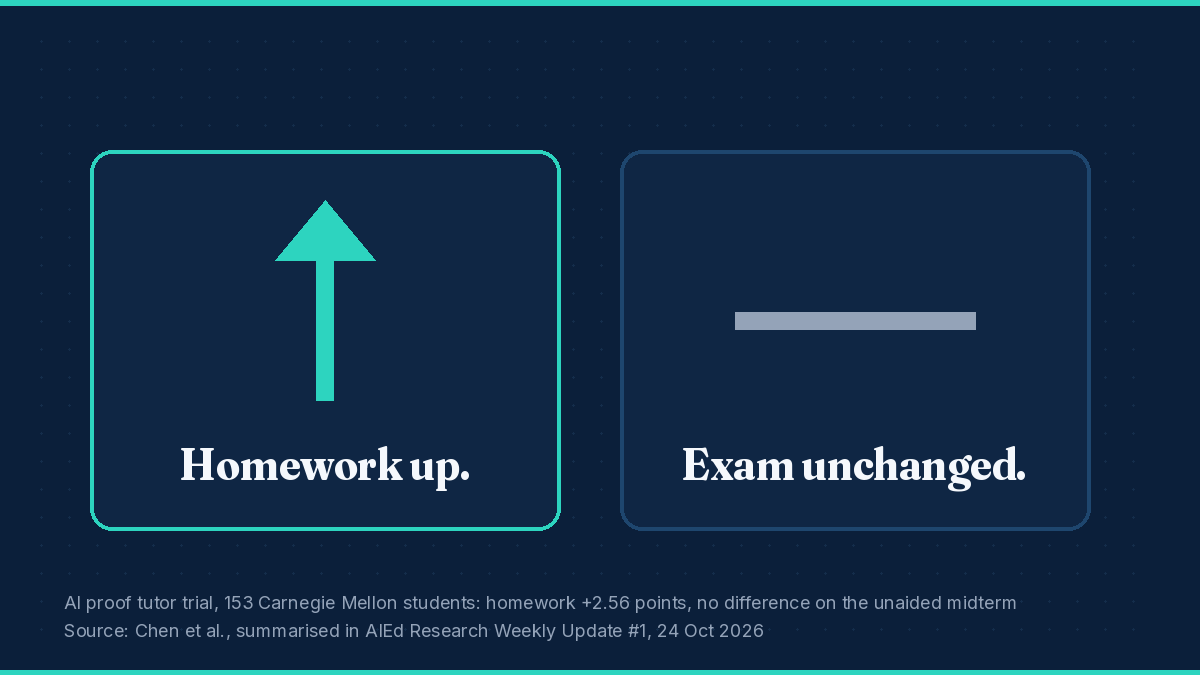
Homework went up; the unaided exam didn’t move. Source: Chen et al., via AIEd Research Weekly Update #1, 24 Oct 2026.
3. Oxford and the DfE launch a project on how pupils’ data should be used for AI
Source: Kristina Khoo-Rhodes, University of Oxford Department of Education · 26 October 2026
A six-month project, Publicly Funded Pupil Data as a Strategic Asset and Public Good, launched today. It was co-designed with the Department for Education and is funded by an ESRC React Award. It will look at how anonymised pupil-generated data could be used for AI research and tools, “while first and foremost, protecting children’s rights and maintaining public trust”. Partners include the DfE, Ofqual and Oak National Academy, with support from Baroness Beeban Kidron. Promised outputs include a governance framework for pupil data, guidance on a “Pupil Data Commons”, and recommendations for future AI assurance and certification.
X reaction: None yet (published this morning).
Video angle: “Your child’s schoolwork is data. Who gets to train AI on it? England just started deciding.”
4. India: NCERT releases a 20-hour AI module for Classes 9–12
Source: PTI via The Hindu · 25 October 2026 · also Education Times · 25 October 2026
India’s national curriculum body has released an activity-based, 20-hour introductory module on computational thinking and AI for Classes 9 to 12. It was developed with IIT Madras and IIT Jodhpur and needs no prior knowledge. It covers how machines learn from examples, detecting deepfakes, data privacy, misinformation, fairness and checking AI output, and can be taught with or without devices. NCERT wants students to be “careful, confident, creative, and responsible users and evaluators of AI systems, rather than relying on its outputs without verification”.
X reaction: @EconomicTimes (5,054 impressions) · @India_tech_news: “Students will learn how AI works, spot deepfakes, protect data privacy and use AI responsibly.”
Video angle: “Twenty hours, no devices needed, and the main lesson is: don’t trust the AI until you’ve checked it.”
5. Australia: teachers’ union tells the Senate that AI has “shifted”, not cut, workload
Source: Adam Vidler, Nine.com.au · 24 October 2026
Nicole Calnan, federal secretary of the Australian Education Union, told the Joint Senate Committee on Artificial Intelligence that “Governments have promoted AI as a way to reduce teacher workload yet our members experience and their available research is that it shifts their time into checking and reworking outputs.” She warned that leaving AI training to the companies selling AI “risks access following existing patterns of disadvantage”, and said reports to the eSafety Commission of sexualised deepfakes targeting students and teachers had doubled in 18 months. A nine.com.au poll of 1,209 people found 28% want chatbots kept out of schools entirely and 85% don’t want them in primary schools.
X reaction: No relevant X reaction found.
Video angle: “Teachers were promised AI would cut their workload. Their union says it’s just turned them into AI checkers.”
6. South Korea: about 600 students resit a midterm after an AI-cheating boast 23 Oct · 72h window
Source: Choi Youngchan, The Asia Business Daily · 23 October 2026 · also Seoul Economic Daily · 23 October 2026
A Konkuk University professor voided an online midterm, held on 19 October for a general-education course of about 600 students, after a student posted on a campus forum that they had scored 99 using AI answers. The professor wrote that “the fairness and ability of the exam to distinguish between students were not adequately ensured because some students cheated, including by using AI”. Everyone resits in person on 14 December.
X reaction: @yonhaptweet (5,499 impressions) · @KBSnews (3,086) · @zzeong__: “와 599명은 무슨죄냐, 불쌍해…..” (roughly: “What did the other 599 do wrong? Poor them.”)
Video angle: “One student bragged about scoring 99 with AI. Now 600 people have to resit.”
7. Bihar signs up 11 IT firms, including Google Education, to train teachers in AI
Source: B K Mishra, The Times of India · 25 October 2026
Bihar’s education department has partnered with 11 IT companies, including Google Education, to train government school teachers in IT and AI in phases through the state’s SCERT, with arrangements due by January. Computer education is set to become compulsory from Class VI in government schools next academic session, starting with smart classrooms in 700 model schools, and university faculty face mandatory AI training.
X reaction: No X reaction found in the window.
Video angle: “Eleven tech companies are about to train a state’s teachers in AI. Should the people selling the tools be the ones teaching them?”
Check the learning, not the score (Stories 1 and 2)
The Alpha School data and the Carnegie Mellon trial tell the same story: AI can lift the visible number without lifting what the child can do alone. One habit answers both: after any AI-helped task, do one question with the tool closed. Runner-up: the Konkuk resit.
“An AI school promised double-speed learning, and a university trial saw homework scores jump. In both cases, the test with the AI switched off told a different story.”
Want this digest in your inbox? A short roundup of what’s actually changing in AI and learning.
Join the newsletter →