Seven stories, one thread: exams and schools are getting serious about proving the work is yours. Oxford’s investigations into AI cheating rose from one to 35 in three years, with capped resits and expulsions. South Korea will seek criminal charges for AI smart-glasses cheating before this month’s national exam, as a lab study finds AI can read blurred SAT papers. A London teacher and Micro:bit call for a GCSE in AI, as a survey finds only 15% of teens feel properly guided. A new AI tutor is trained to make students think, though it is so far tested only on simulated learners. And in the US, one district makes every assignment AI-free by default, Utah lets students help write the rules, and Wyoming offers a free AI-literacy course. The takeaway for families: do the first attempt yourself, and you never have to prove anything.
1. Oxford: AI-cheating investigations up 46% in a year
Source: Ned Remington, Cherwell (Oxford student newspaper) · 1 November 2026
A Freedom of Information request by Cherwell shows Oxford University ran 35 investigations into unauthorised AI use in assessments in 2025–26, up from 24 in 2024–25 and just one in 2023–24. Just over half of all such cases since September 2023 (31 of 60) came from the Social Sciences Division. Of the concluded cases, the most common outcome was a capped resit (28 times), where the best grade available is usually a pass; three students were permanently expelled. The rise comes after Oxford gave every student access to ChatGPT Edu last September.
X reaction: No X posts about the Cherwell story were found (search for “Oxford AI plagiarism investigations” since 31 Oct returned 0).
Video angle: “One case three years ago. Thirty-five last year. Here’s what happens at Oxford if you’re caught using AI.”
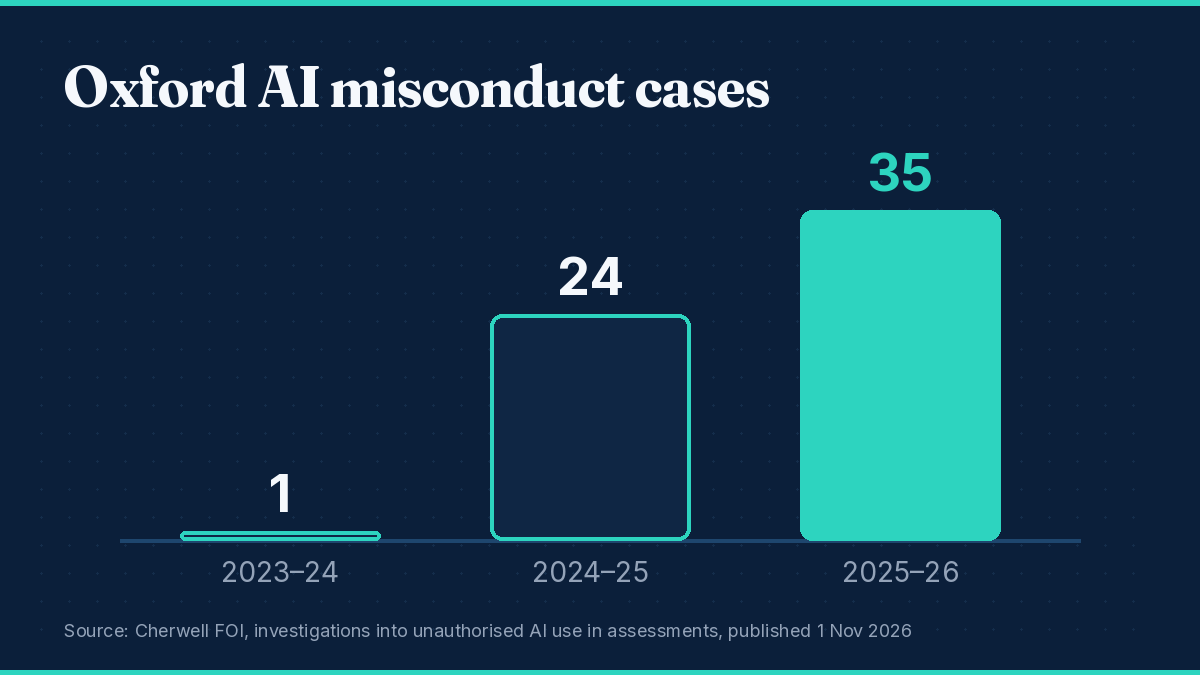
Oxford investigations into unauthorised AI use in assessments. Source: Cherwell FOI, 1 Nov 2026.
2. South Korea: criminal charges for AI smart-glasses cheating, as a study shows AI can read blurred exam papers
Source: Korea JoongAng Daily · 29 October 2026 72h+ window, labelled · study coverage: NoCut News / Yonhap · 1 November 2026 and The Asia Business Daily · 1 November 2026
Korea’s Ministry of Education says students caught using AI-powered smart glasses in the national university entrance exam (CSAT, on 19 November) may face police investigation and criminal charges, and it wants to extend the retake ban from one year to three. Every one of the 1,312 test sites will have a staff member dedicated to spotting smart glasses. It follows cases at Yonsei University and the University of Seoul, where applicants wore ordinary glasses at the pre-exam check and swapped to smart glasses during the test. On 1 November, Yonhap highlighted a German study (Urbanski and Peters, Martin Luther University Halle-Wittenberg) in which Google’s Gemini 1.5 Pro answered 82.78% of 720 past SAT questions correctly from deliberately blurred, angled images, and GPT-4o 75.69%. The researchers simulated the images; they did not test real glasses in a real exam hall.
X reaction: Wide link-sharing, e.g. @channelstv (AFP) and @ennyola0015; @LinHindsight: “We used to worry about students hiding notes in their sleeves. Now the notes can be right in front of their eyes.”
Video angle: “They look like normal glasses. In a lab test, AI read blurred exam questions through them and got more than 80% right.”
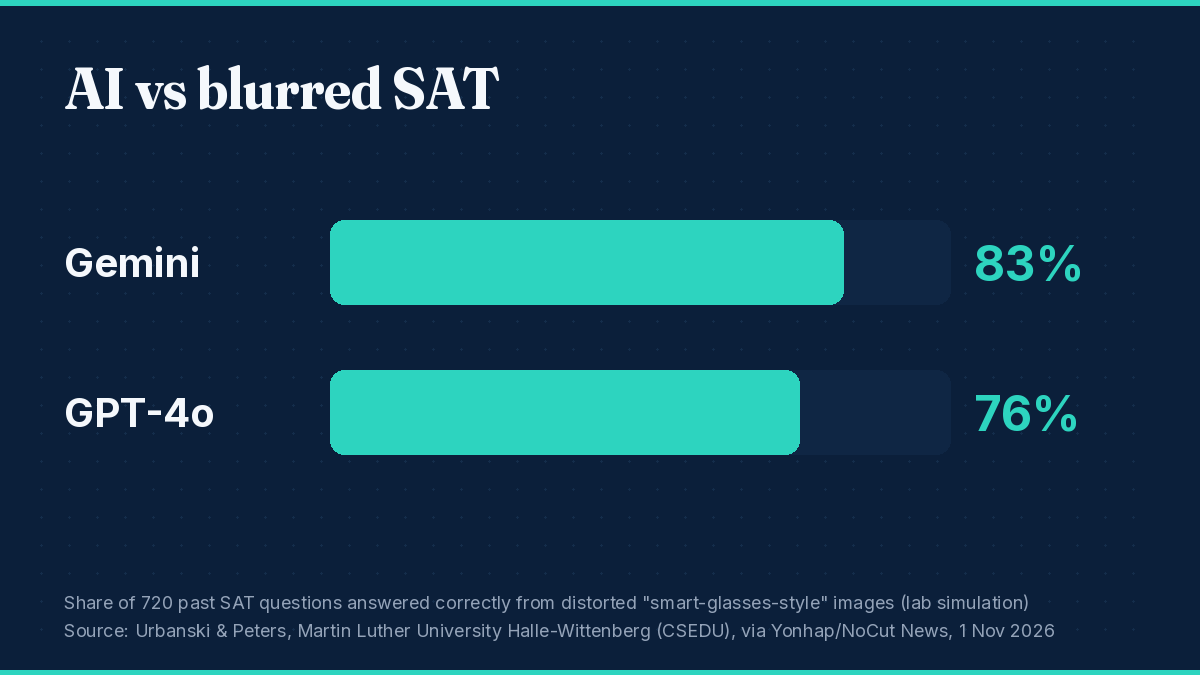
Lab simulation, not a real exam. Source: Urbanski & Peters via Yonhap/NoCut News, 1 Nov 2026.
3. UK: a London teacher, and Micro:bit, call for a “GCSE in AI”
Source: Metro · 1 November 2026
Metro profiles Kasia Suliga Wasielewska, a teacher at a north London school who builds AI into lessons: ChatGPT-generated quizzes, students fact-checking Gemini’s answers, and Micro:bit’s CreateAI tool to show young pupils how machine learning works. She says pupils as young as eight use AI for homework, and insists “AI must support, not replace, the teacher’s expertise.” The Micro:bit Educational Foundation wants the government to introduce an AI GCSE. Metro cites an Oxford University Press survey: more than nine in 10 teens use AI, but only 15% feel they’ve had enough guidance. The Department for Education told Metro it is co-designing AI tutoring tools with teachers and investing £23 million to find which technologies work best in schools.
X reaction: @MetroUK shared it (4 replies at time of check); @OpenEyeComms quoted the Micro:bit call.
Video angle: “More than nine in 10 teens use AI. Only 15% say anyone has taught them how.”
4. humans& launches &Tutor, an AI model trained to teach
Source: humans&, “Introducing &Tutor” and model card · 30 October 2026 72h window
AI lab humans& released Ampersand Tutor (&Tutor) through its API. It was trained against “Persimmon”, a model that simulates a human learner, and rewarded by how much the simulated student learns. On TutorMoments, a benchmark built from real maths tutoring moments, it scored 0.754 under a plain prompt, ahead of Claude Sonnet 5.5 (0.667) and GPT-6 Astra (0.634); with an evaluation-aware prompt it scored 0.919, just behind GPT-6 Astra (0.926). The company’s own limitations section says results with simulated learners and AI judges “may not generalize to human learners” and that short evaluations “do not establish lasting learning gains.”
X reaction: Launch post from @humansand; X’s trending summary (“New &Tutor AI Sparks Homeschooling Debate”) describes parents debating AI-led homeschooling, with critics worried about social skills.
Video angle: “A new AI was trained to teach by practising on a fake student. Here’s why that matters, and what it hasn’t proved yet.”
5. Howard County, Maryland: every assignment is AI-free unless the teacher says otherwise
Source: Kiersten Hacker, Baltimore Sun (via GovTech) · 30 October 2026 72h window
Howard County’s Board of Education approved an AI policy on Thursday 29 October, a week after Maryland’s deadline under its AI Ready Schools Act. All assignments are AI-free unless a teacher allows AI; when they do, students must follow set limits and disclose or cite their use. Staff may use AI for lesson planning, drafting messages or translation, but not for grading, counselling or entering personal data. Neighbouring Frederick County has banned student AI use in all grades, with limited exceptions. Student board member Mark Li said guidelines aren’t clear to students, and that when pupils can tell teachers used AI, they think, “Teachers used AI, so there’s nothing wrong if I do it.”
X reaction: @baltimoresun shared the story (3 quote posts at time of check).
Video angle: “One school district’s new rule fits on a fridge magnet: no AI unless your teacher says yes.”
6. Utah gives students a seat at the table on classroom AI rules
Source: Brooke Nally, KSL.com · 1 November 2026
The Utah State Board of Education has created an Artificial Intelligence Student Task Force, approved on 1 October, to feed student views into AI policy. It began with Skyline High School senior Rahul Nair, who read Utah’s AI framework, found little student voice in it, and wrote a charter for the task force. Hillcrest High senior Kennedy Mickelson joined with a more cautious view of AI. Nair’s question: if AI policies are being passed almost daily, why aren’t students being asked?
X reaction: No X reaction found (searched since 29 Oct).
Video angle: “Two students disagreed about AI in school, so they joined the group writing the rules.”
7. Wyoming offers every high school a free AI-literacy course and microcredential
Source: Wyoming Department of Education, superintendents’ memo for 2 November 2026 · page dated 28 October 2026 memo issue dated 2 Nov
Wyoming has partnered with Evergreen Education to offer Everwise, a self-paced AI literacy course of about 15 hours for grades 9–12, free to every high school. Students learn how AI tools work, where they go wrong, how to check what AI tells them, and when AI helps or gets in the way. The course neither pushes students to use AI nor to avoid it; each student writes a personal “AI Constitution.” Finishers earn a state-backed microcredential. An enrolment webinar is on 12 November.
X reaction: No X reaction found.
Video angle: “One US state is asking every teenager to write their own ‘AI constitution’.”
Want this digest in your inbox? A short roundup of what’s actually changing in AI and learning.
Join the newsletter →