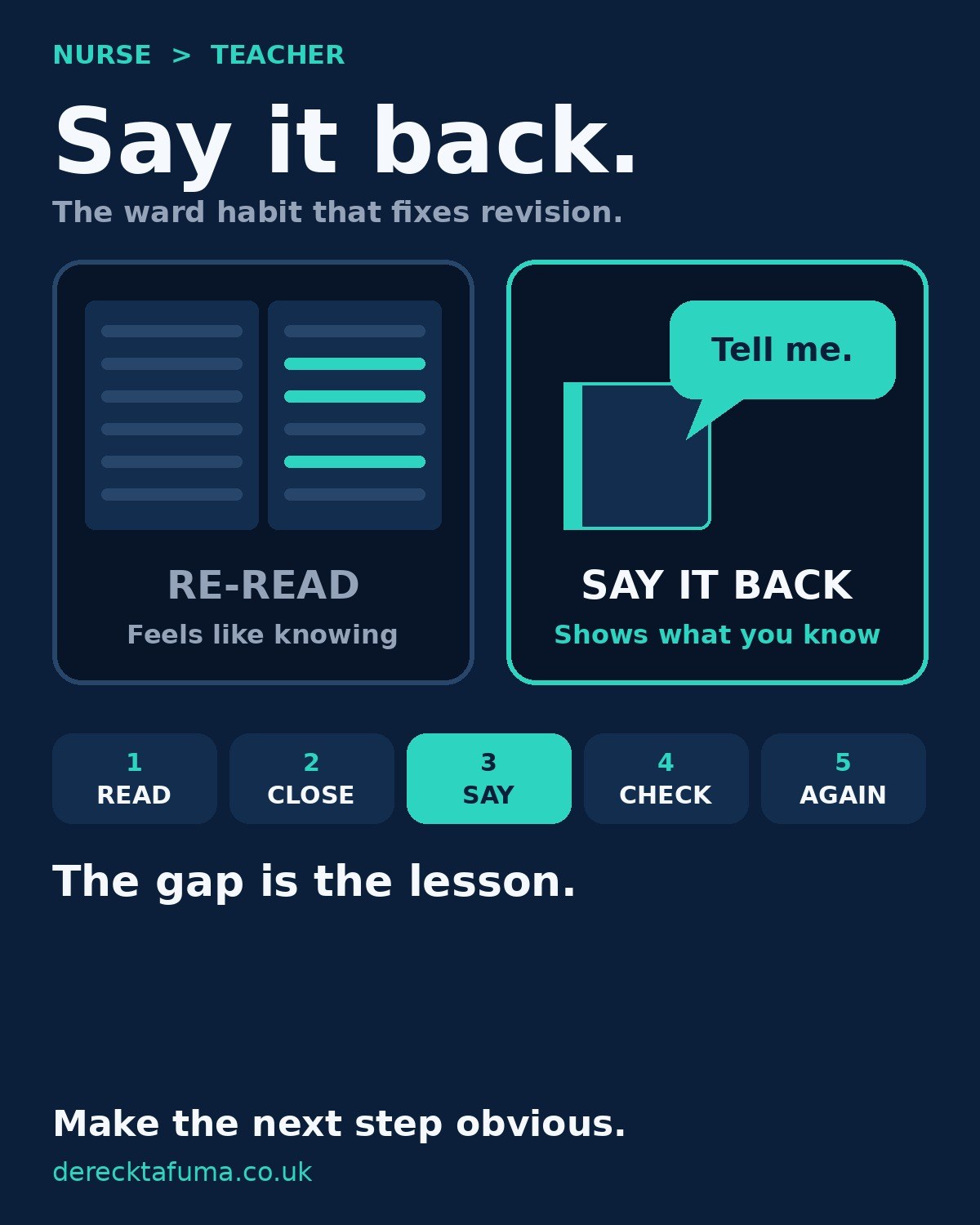
Say it back: the ward habit that fixes revision
One of the first habits you learn in nursing is not clever at all. Someone tells you something important, and before you do anything, you say it back.
"So that's the morning dose, not the evening one?"
"Yes."
It takes four seconds. It feels a bit awkward the first few times. And it catches mistakes that nothing else catches, because it tests the one thing that matters: what actually landed in your head, not what was said, written down or meant.
I've taught and tutored for years too, and I think this is the most useful thing nursing ever taught me about learning. Most revision fails for the same reason most misheard instructions fail. Nobody checks what landed.
Re-reading is a nod, not a read-back
Watch a student revise and you'll usually see the same thing. Notes open. Highlighter out. Page read once, then read again. Maybe a colour or two added.
It feels productive. The page starts to look familiar, and familiar feels like knowing.
But familiar is not the same as knowing. Recognising a page when it's in front of you is a much easier task than producing it when the page is gone, and the exam only ever asks for the second one. The paper doesn't show you your notes and ask if they look right. It gives you a blank space and waits.
Re-reading is like nodding along to an instruction. You heard it. You agreed with it. You never said it back, so you never found out what you missed.
What "say it back" looks like at a desk
The habit is simple enough to start tonight:
- Read one small chunk. One section, one diagram, one definition. Not a whole topic.
- Close the book. Properly. Turn the notes face down.
- Say it back. Out loud, or on a blank sheet. Explain it as if you're telling someone who wasn't in the room.
- Open the book and check. What did you get right? What did you leave out? What did you get wrong?
- Mark the gap and go again. Only the bit you missed. Then say it back once more.
That's it. No app, no new stationery, no timetable rebuild.
The magic is in step four. On a ward, the read-back matters because the other person can say "no, the evening one". At a desk, your notes play that part. The gap between what you said and what's on the page is the most useful information you'll get all day, because it tells you exactly what to revise next.
Why it works
Researchers who study learning call this retrieval practice, and it's one of the most consistently supported revision methods there is. Pulling something out of memory strengthens it far more than putting it in again. Each time you say it back, you're not just checking, you're building the route you'll need in the exam hall.
It also kills the most dangerous feeling in revision: "I know this." You only find out whether you know it when the book is shut.
The awkward bit
Saying it back feels worse than re-reading. That's normal, and it's the point.
The first time a new nurse reads an instruction back, it can feel like you're doubting the person who gave it. You're not. You're making sure. After a few weeks nobody thinks twice, because everyone has seen what it catches.
Revision is the same. The first few times you close the book you'll stumble, go blank, and realise how much you didn't know. That's not failure. That's the check working. A gap found at your desk in October is a gap you won't find in the exam hall in May.
If you're a parent, this is also the easiest way to help without being an expert. You don't need to know the subject. Just hold the notes and say, "Go on then, tell me." Then follow along as they talk. Where they stop is where the next twenty minutes of revision should go.
Five minutes this half term
If you're revising this half term, don't plan a bigger timetable. Plan a smaller check. Pick one topic a day. Read a chunk, close the book, say it back, check, and go again on the gap. Five minutes is enough to start. Most students who try it properly for a week don't go back to highlighting.
The habit I took from the ward is the same one I'd give any student: don't trust that it landed. Say it back.
Your next step
To practise, grab the free RevisionLab revision sheet. It's two A4 pages, ready to read, close and say back tonight: download the free revision sheet. More RevisionLab resources, including the Mock Booster, are coming soon.
Download the free revision sheet →
— Dereck Tafuma