
People usually ask me to pick one. Are you a teacher or a nurse? Do you do science tuition or do you write about diet and money? The honest answer is that I've never experienced them as separate jobs. They're the same work in different uniforms.
The Isle of Youth, in a language I didn't speak
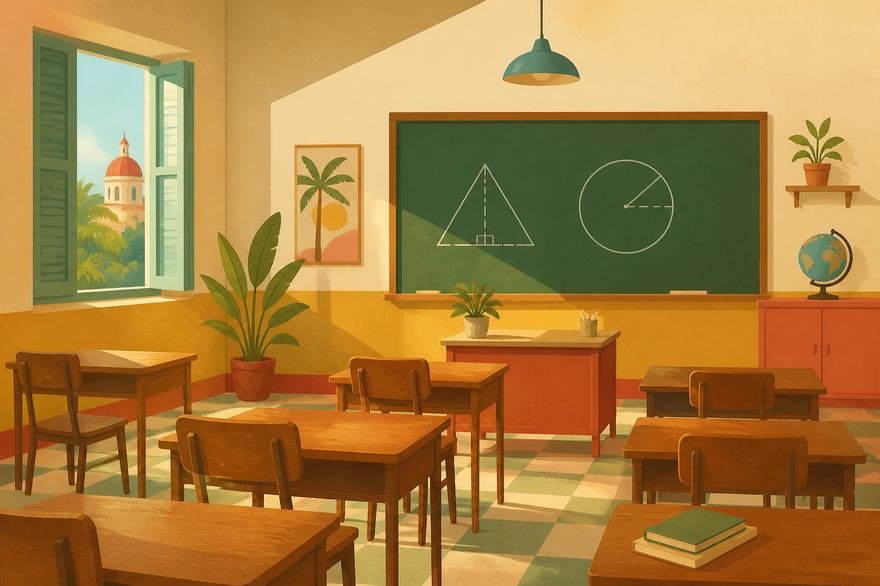
In 1994 I left Zimbabwe for Cuba on a five-year teacher training programme, at the Filial Pedagógica Universitaria "Carlos Manuel de Céspedes" on the Isla de la Juventud — a campus of the Instituto Superior Pedagógico "Enrique José Varona" in Havana. I was going to be a physics teacher. There was one complication: every lecture, every textbook, every exam would be in Spanish, and I didn't speak a word of it.
The island is worth explaining, because most people in Britain have never heard of it. It used to be called the Isle of Pines. In 1978 Cuba renamed it the Isle of Youth — Isla de la Juventud — after the young people it had begun bringing there from abroad. For roughly two decades the Cuban government ran a network of internationalist boarding schools on that island, educating students from dozens of countries across Africa, Asia and Latin America: Angolans, Mozambicans, Namibians, Ethiopians, Sahrawis, Zimbabweans. There was a sign in Nueva Gerona that said the Isle of Youth would be the island of African youth. It very nearly was.
I arrived near the end of that era — the programme wound down not long after — which means I'm part of a fairly small group of people who saw it while it was still running. It is a genuinely strange thing to carry around: a chapter of Cold War history that barely exists in English, that I happen to have five years of, in Spanish, in my own memory. I intend to write it down properly before it goes.
Cuban lecturers flew out to Zimbabwe ahead of us and taught us Spanish for about three months before we travelled. Three months. By the time we landed we could follow perhaps a third of what was being said, which turned out to be enough to start. The first two years were as much a language course as a physics degree — learning mechanics and learning the vocabulary to think about mechanics, at the same time, in a language I was still assembling as I went.
There were five subject cohorts — physics, chemistry, maths, biology and geography — with around 150 of us training in each. Several hundred Zimbabweans, all learning to teach, all doing it in a second language, a very long way from home. Fidel Castro was president for the entire five years I was there. There are a great many stories from that time, and I'll be telling them properly on this site.
That experience is the foundation of how I teach. The Cuban system starts from an assumption that sounds obvious and almost never survives contact with reality: every student can learn this, and if they haven't, the teaching is what needs to change. There's no comfortable category called "not a maths person" to file a struggling child into. You go back, find the exact point where the understanding broke, and rebuild from there.
Thirty years later it's still the first thing I do with a new student. Before we touch the syllabus, I want to know where it stopped making sense — because it is almost never where they think it is. A Year 12 who can't do the mechanics questions usually has something from Year 9 that nobody caught.
Zimbabwe: my first five years in front of a class
I came home in 1999, and that September I started my first teaching job at Selonga Secondary School in Gwanda, Matabeleland South. I was there just under two years before moving to Bulawayo, where I taught at Luveve High School and then at Bulawayo Adventist Secondary School. How I ended up at each of them is a story in itself, and one I'll tell separately.
Large classes. Not enough textbooks. Students who wanted it badly. It teaches you quickly that engagement isn't something you manufacture with a clever starter activity — those students arrived with it. What they needed from me was clarity, structure, and the sense that the effort would be repaid. Everything I know about explaining a hard idea simply, I learned in rooms with almost no equipment, where the explanation was the only resource I had.
I left in 2004, as the economy was beginning to come apart. The worst of it came after I'd gone: by 2008 the currency my family held had been reduced to nothing, and savings that represented decades of work simply evaporated. Watching that happen to people you love, from four thousand miles away, changes what you think money is. It stops being an abstraction and becomes a promise somebody else can break. That is the reason I take Bitcoin seriously, and why I write about it the way I do — as a question about trust, not a trade.
England: starting again at the bottom
I came to the UK in 2004 and taught here for fifteen years, mostly as a supply teacher, before qualifying for QTS in 2018.
I'll be honest about what that was. I arrived with a five-year physics degree earned in a second language and spent years being treated as a temporary body at the front of the room. It was slow, and at times it was humbling. It also turned out to be an unusual education in its own right: supply took me into a very large number of schools, year groups and classrooms — far more than a teacher who stays in one department ever sees. You learn to read a room in ninety seconds. You learn which explanations survive contact with a class that has no reason to give you the benefit of the doubt.
Teaching the same physics in two education systems also makes certain things visible. GCSE and A-Level are not really tests of whether a student understands science. They are tests of whether a student can express that understanding in the particular way this exam board wants it said. That's a separate, learnable skill, and most students are never taught it explicitly. An enormous amount of what looks like ability is just knowing what the mark scheme is asking for.
And I have a great deal of sympathy for students who feel behind, because I have been behind. Requalifying in your forties, in a country that doesn't quite recognise what you already are, is its own long lesson.
The ward: what pressure does to people
In 2019 I changed direction and trained as a mental health nurse, qualifying in 2022. I've worked as a registered mental health nurse ever since, on a psychiatric intensive care unit — the most acute end of mental health care, the point at which somebody is too unwell to be safe anywhere else.
People assume that's a total career change. It isn't. On a PICU you are doing what a good teacher does, at higher stakes: reading a room, noticing the thing nobody has said out loud, de-escalating, explaining something difficult to someone who is in no state to hear it, and holding a boundary kindly. The uniform changed. The work didn't.
I don't write about what happens on the ward. That isn't my story to tell, and confidentiality is not a technicality I get to weigh against a good anecdote. What I do write about is everything that happens before anyone reaches a place like mine: how families miss the early signs, how hard the system is to navigate if nobody has shown you how, and how much avoidable suffering happens simply because people don't know who to ring.
That's a teaching problem as much as a clinical one, and it's why there's a whole section of this site about recognising mental illness and getting help. It's written for the public, not for clinicians — and particularly for families like the ones I grew up around, where mental illness carries a stigma heavy enough that nobody names it out loud until it's an emergency.
Now: nursing, teaching, and building
These days I do all of it. I live in Corby and tutor physics, maths, chemistry and biology at GCSE and A-Level across every UK exam board — online over Zoom since covid, and in person locally. I also run RevisionLab, which turns the way I teach into revision hubs students can work through on their own.
Somewhere in all of that I picked up five languages: English, Shona and Ndebele from home, Spanish out of necessity, and enough French to be dangerous. Which is a roundabout way of saying I have a lot of patience for people who are struggling to put something into words. I've spent years being the person in the room who couldn't.
I also build. I run online businesses across e-commerce, publishing and education, and I use AI the way I'd use any other tool — to take the repetitive work so I can spend my hours on the parts that need a human. I write about how, in plain English, with no income claims attached.
And I train. Carnivore diet, calisthenics, no gym membership and no supplement bill. I write that up as an experiment run on a single subject — me — rather than as advice, because that's honestly all it is.
Why it's all on one website
I know the conventional advice. Pick a niche. Be one thing. Give the algorithm something it can categorise. I've decided not to do that here, for a simple reason: this is my website, not a channel. It's the place the whole person lives.
And the interests are less scattered than they look. Teaching a teenager to actually understand mechanics; helping a family recognise that their son is unwell; working out what to eat and how to train; understanding money well enough not to be robbed by it — these are all the same problem. Somebody hands you the official version. You find out it doesn't survive contact with reality. So you go and work out what's actually true, test it on yourself, and then explain it to the next person clearly enough that they don't have to start from scratch.
That's the whole job. It always has been. Teaching just happens to be the only word we have for it.
The short version
- Trained
- Five-year physics teaching degree, Cuba, 1994–1999 — studied entirely in Spanish. Filial Pedagógica Universitaria "Carlos Manuel de Céspedes", Isla de la Juventud, part of the Instituto Superior Pedagógico "Enrique José Varona", Havana.
- Teaching
- Twenty years in the classroom: five in Zimbabwe (Gwanda and Bulawayo), fifteen in England. QTS, 2018.
- Tutoring
- Physics, maths, chemistry and biology. GCSE and A-Level, all UK exam boards — AQA, Edexcel, OCR, WJEC/Eduqas and Cambridge International.
- Nursing
- Registered Mental Health Nurse, NMC PIN held. Qualified 2022. Psychiatric intensive care.
- Building
- Online businesses across e-commerce, publishing and education, run with AI systems.
- Languages
- English, Shona, Ndebele, Spanish, and a little French.
- Elsewhere
- Longer essays are also published on Medium.
- Based
- Corby, Northamptonshire. Tutoring online over Zoom, and in person locally.