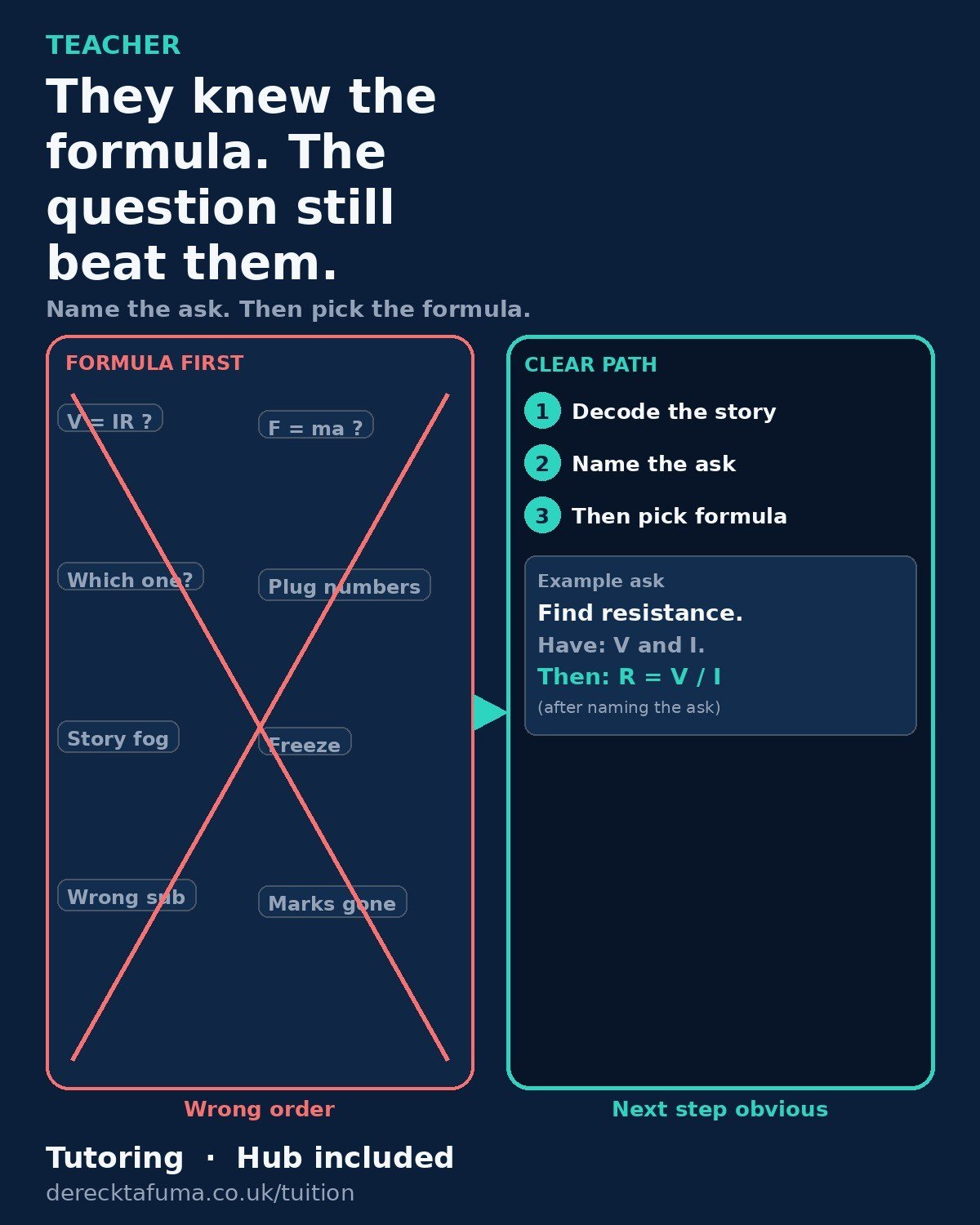
They knew the formula. The question still beat them.
I keep meeting the same student.
They can recite V = IR. They can write F = ma without blinking. Flashcards done. Formula sheet almost memorised. Then the paper puts the same idea inside a story — a heater, a wire, a trolley that slows down — and they freeze.
Not because they are weak. Because they reached for the formula before they named what the question was asking.
I’m Dereck Tafuma — teacher, nurse, builder. I turn hard subjects into things people can actually use. In a classroom, on a ward, and on a messy brief, the craft is the same: make the next step obvious. This week’s lesson is that craft applied to Physics papers.
The trap
Memorising formulas feels like progress. It is progress — until the exam stops asking “state Ohm’s law” and starts asking something that looks like English.
A typical story might go like this (illustrative only — boards vary):
A metal wire is connected to a battery. You are given the current through the wire and the potential difference across it. Find the resistance.
Or:
A trolley of known mass is pushed with a constant force. You are told how its velocity changes over a short time. Find the acceleration, then check whether the force matches F = ma.
Neither line says “use V = IR” or “use F = ma” in bold. So the student who only practised plugging numbers into a remembered letter soup looks at the paragraph and thinks: I don’t know this topic.
They did know the topic. They skipped the step that makes the formula usable.
Name the ask first
Before you touch the equation, say out loud — or write in the margin — one clear sentence:
What is this question actually asking me to find?
Resistance? Acceleration? Force? Current? Energy transferred?
If you cannot name the quantity in plain English, you are not ready for the formula yet. That is not failure. That is diagnosis.
Nursing works the same way. You don’t start with the fanciest kit. You start with: what is wrong, what do we need next, who does what. Clarity first. Tool second.
Building a website for a local business is the same spine. You don’t open five AI tabs before you can say what the customer should do next. Name the ask. Then pick the method.
Physics exams punish the reverse order. Formula first → story still foggy → wrong substitution → marks gone.
Decode the story into one ask
Here is a simple sequence I teach. Use it on the next practice paper.
- Underline the thing you must find. Not the whole paragraph — the target. “Find the resistance.” “Calculate the acceleration.”
- List what you already have. Numbers, units, and what each number means in the story (current, voltage, mass, change in velocity, time).
- Cross out the decoration. The heater brand, the colour of the trolley, the journey to school — unless it changes a quantity, it is noise.
- Only then pick the formula that links what you have to what you need.
For an Ohm’s-law style ask: if you need resistance, and you have potential difference and current, V = IR rearranged to R = V / I is the path — after you have named “find R”.
For a force-and-motion style ask: if you need force and you have mass and acceleration (or can find acceleration from a change in velocity and time), F = ma is the path — after you have named “find F” (or “find a”).
I am not claiming every board question is this clean. Some questions stack steps. Some hide a unit conversion. Some want you to explain, not calculate. The spine still holds: decode the story into one clear ask, then pick the formula.
Why bright students still freeze
Because school rewards speed on drill sheets. Drill sheets often hand you the letters already. The exam hands you a story.
So the student who “knew the formula” practiced the second half of the skill. They never practiced the first half: turning English into a named quantity.
That is teachable. It is not magic. It is the same habit as rewriting a messy brief into one next step before you build anything.
A five-minute test (use tonight)
Open one past-paper question that looks like a paragraph.
Cover the formula sheet with your hand.
Write only:
- Target (what to find)
- Givens (what you have)
- Formula that links them
Then uncover the sheet and check. If your target was wrong, the formula never had a chance.
Do three questions like that. Not thirty flashcards. Three named asks.
What I won’t sell you
I won’t sell you an AI course, a prompt pack, or “AI for exams” as the product.
AI can help me draft explanations faster. It does not replace a student who can name the ask. Year bets for me stay simple: clear revision paths for students (tuition and the Student Hub), and clear websites for local businesses (Tafuma Web Services). AI sits behind the work. It is not a third money door.
The lesson, one line
They knew the formula. The question still beat them — because they grabbed the equation before they named the ask.
Make the next step obvious: decode the story, then pick the formula.
If you want tutoring where that habit is trained on real paper-style questions — and the Student Hub is included in the hourly rate — that is the work I do here:
Teacher. Nurse. Builder. Same craft: make the next step obvious.
— Dereck Tafuma